Thomas Hoving's charismatic but controversial leadership of New York's Metropolitan Museum of Art is summed up in his autobiography Making the Mummies Dance.
Dr. Hoving died yesterday of lung cancer at his Manhattan home, his family said.
As the director of the Metropolitan Museum of Art from 1967 to 1977, he turned an institution he said was "dying" into a happening museum with blockbuster exhibits. The treasures from Egyptian King Tutankhamun's tomb was the most popular exhibit in the museum's history, drawing more than one million visitors in New York, plus another 5.6 million at five other American museums.
But Dr. Hoving also raised dust in other ways, paying $5.5-million for a Velazquez masterpiece while selling works by Van Gogh and others to help pay for it. And he had no qualms about letting people sit and snack on the museum's front staircase, which he had enlarged.
Dr. Hoving's philosophy was: anything to make people notice great art.
[...]
Labels: art, biography, history, obit, people
posted by Sal Towse at 10:07 PM|

 |
|
|
|
Something someone said led me today to SOS! Canadian Disasters
For those who don't know much about Canadian history and those who do. ...
This site uses digitized collection material from Library and Archives Canada to feature 15 historical and contemporary disasters grouped under elemental the themes of Fire, Air, Earth and Water, plus the distinctly Canadian element of Ice. Each of these disasters has had a profound and life-altering impact on Canadian communities, families, and society in general. The site looks at these selected events, their scale, and their news coverage. This phase of the site also features a section on Shipwreck investigations in Canada.
posted by Sal Towse at 5:25 PM|
|
|
Last week Maddow and Pat Buchanan got into a brouhaha over Sotomayor's nomination to the Supreme Court and affirmative action, which Maddow supports but Buchanan does not.
Here is a snippet where Maddow corrects some of the "facts" presented by Buchanan during the debate.
Visit msnbc.com for Breaking News, World News, and News about the Economy
The original debate is here:
Visit msnbc.com for Breaking News, World News, and News about the Economy
posted by Sal Towse at 9:34 AM|
|
|
Yes, indeedy.
A plimsoll shoe or simply plimsoll is a type of athletic shoe with a canvas upper and rubber sole, developed as beachwear in the 1830s by the Liverpool Rubber Company (later to become Dunlop). The shoe was originally, and often still is in parts of the UK, called a 'sand shoe' and acquired the nickname 'plimsoll' in the 1870s. This name derived, according to Nicholette Jones' book "The Plimsoll Sensation" because the colored horizontal band joining the upper to the sole resembled the Plimsoll line on a ship's hull, or because, just like the Plimsoll line on a ship, if water got above the line of the rubber sole, the wearer would get wet.
We'd been looking at an incoming container ship and I was wondering if the plimsoll shoe got its name because of the resemblance of the demarcation between the shoe's rubber sole and canvas upper and the Plimsoll line on the ship.
The Web is a wonder.
Labels: factoid, history, wordstuff
posted by Sal Towse at 5:31 PM|
|
|
It was on this day in 1731 that Ben Franklin founded the first circulating library, a forerunner to the now ubiquitous free public library. He started it as a way to help settle intellectual arguments among his group of Philadelphia friends, the Junto, a group of civic-minded individuals gathered together to discuss the important issues of their day.
[...]
[from Jessamyn West's blog: librarian.net]
Labels: factoid, history, libraries
posted by Sal Towse at 5:07 PM|
|
|
One difference, the newer edition has a foreword by MFK Fisher.
One other crucial difference, for those of us who spent our young adult years in the sixties and seventies, this edition contains the recipe that (for legal reasons) the publisher could not include in the first edition. Yes, the recipe for Haschich Fudge -- no, not brownies ... fudge, even though the talk was always of Alice B. Toklas brownies.
The Haschich Fudge recipe is not a Toklas original, but rather came to Toklas from painter and film-maker Brion Gysin, according to the notes.
-------------
Haschich Fudge (which anyone could whip up on a rainy day)
This is the food of Paradise -- of Baudelaire's Artificial Paradises: it might provide an entertaining refreshment for a Ladies' Bridge Club or a chapter meeting of the DAR. In Morocco it is thought to be good for warding off the common cold in damp winter weather and is, indeed, more effective if taken with large quantities of mint tea. Euphoria and brilliant storms of laughter; ecstatic reveries and extensions of one's personality on several simultaneous planes are to be complacently expected. Almost anything Saint Theresa did, you can do better if you can bear to be ravished by 'un évanouissement reveillé.'
Take 1 teaspoon of black peppercorns, 1 whole nutmeg, 4 average sticks of cinnamon, 1 teaspoon of coriander. These should be pulverised in a mortar. About a handful each of stoned dates, dried figs, shelled almonds and peanuts: chop these and mix them together. A bunch of canibus sativa [sic] can be pulverised. This along with the spices should be dusted over the mixed fruit and nuts, kneaded together. About a cup of sugar dissolved in a big pat of butter. Rolled into a cake and cut into pieces or made into balls about the size of a walnut, it should be eaten with care. Two pieces are quite sufficient.
Obtaining the canibus may present certain difficulties, but the variety known as canibus sativa grows as a common weed, often unrecognised, everywhere in Europe, Asia and parts of Africa; besides being cultivated as a crop for the manufacture of rope. In the Americas, while often discouraged, its cousin, called canibus indica, has been observed even in city window boxes. It should be picked and dried as soon as it has gone to seed and while the plant is still green.
-------------
Now that I've saved the recipe (although for what reason I don't know), I can pass the copy of the later edition on to someone who will give it a good home.
Labels: books, food, history, recipes, writers, writing
posted by Sal Towse at 2:46 PM|
|
|
from the site: The WDL focuses on significant primary materials, including manuscripts, maps, rare books, recordings, films, prints, photographs, architectural drawings, and other types of primary sources.
See also UNESCO's Memory of the World project.
[via LOC's Twitterfeed]
Labels: history, libraries, maps, photographs, resource, URL
posted by Sal Towse at 10:29 AM|
|
|
An article on his nibs' cousin is the cover feature in the current STANFORD Magazine. Interesting writeup of the happenings at the CFTC in the late nineties.
If they'd listened to Born and implemented her proposals, could it have prevented the meltdown?
Update: She's also getting one of the Kennedy Library Foundation's 2009 Profile in Courage Awards for the days back then.
Labels: financeconomics, history, people
posted by Sal Towse at 9:12 AM|
|
|
[22 Dec 1857] A dreadful murder and suicide took place at the Red House, near the Race Course. The proprietor, SYLVESTER MURPHY, aged 27, a native of PITTSBURG, PA; murdered a servant named MARY ANN MCGLYNN, aged 23, by shooting her in the head and then cutting her throat; afterwards he took his own life by inflicting with a small knife, eight stabs upon his left breast and also by cutting his own throat. The whole affair is wrapped in mystery.
Labels: history, San Francisco, writing
posted by Sal Towse at 2:49 PM|
|
|
The Ceremony was very imposing, and fine and simple, and I think ought to make an everlasting impression on everyone who promises at the altar to keep what he or she promises. Dearest Albert repeated everything very distinctly. I felts so happy when the ring was put on, and by Albert. As soon as the Service was over, the procession returned as it came, with the exception that my beloved Albert led me out. The applause was very great, in the Colour Court as we came through: Lord Melbourne, good man was very much affected during the Ceremony and at the applause. We all returned to the Throne-room, where the Signing of the Register took place: it was first signed by the Archbishop, then by Albert and me, and all the Royal Family, and by: The Lord Chancellor, the Lord President, the Lord Privy Seal, the Duke of Norfolk (as Earl Marshal), the Archbishop of York, and Lord Melbourne. We then went into the Closet, and the Royal Family waited with me there till the ladies had got into their carriages. I gave all the Train-bearers as a brooch a small eagle of turquoies. I then returned to Buckingham Palace alone with Albert: they cheered us really most warmly and heartily; the crowd was immense; and the Hall at Buckingham Palace was full of people; they cheered us again and again. The great Drawing-room and Throne-room were full of people of rank, and numbers of children were there. Lord Melbourne and Lord Clarendon, who had arrived, stood at the door of the Throne-room as we came in. I went and sat on the sofa in my dressing-room with Albert; and we talked together there from 10 m to 2 till 20m. p. 2.
Queen Victoria, 1840
Etching illustrations of the wedding and the procession accompany the entry.
And thus ends the entry for 10 February.
Just received a pkg in the mail from Auntie K who sent a book bought at the Friends of the Library book sale called THE PAST TIMES BOOK OF DIARIES, which works you through each day of the year with an entry from someone's past diary. One hundred diarists. Four hundred years. Eye witness accounts of history (see 10 Feb) and private entries.
Famous folk (QVic, Katherine Mansfield, Beatrix Potter, Samuel Pepys) and some less famous (to me) folk (Ralph Josselin, Francis Kilvert, F.E. Witts), who may be well-known names to those with more depth than I can claim.
That's what the Goog is for.
Ralph Josselin "was the vicar of Earls Colne in Essex from 1641 until his death in 1683. He is celebrated for his remarkable diary rivalling that of Samuel Pepys which records intimate details of everyday farming life, family and kinship in a small, isolated rural community." [Wikipedia]
Francis Kilvert "is best known as the author of voluminous diaries describing rural life. After his death from peritonitis, his diaries were edited and censored, possibly by his widow." [Wikipedia]
F.E. Witts, author of The diary of a Cotswold parson : Reverend F.E. Witts, 1783-1854. [WorldCat] [no Wikipedia entry. Shocking! I know!]
Thanks, Auntie K!
posted by Sal Towse at 2:10 PM|
|
|
Interesting use of Twitter.
[via Biz Stone's twitterfeed]
posted by Sal Towse at 2:02 PM|
|
|
Warren Ellis writes: These are, I’m told, the work of one Sergei Larenkov, and they are wonderful. He’s reshot WW2-era photographs in the present day, from their original perspectives, and then faded the original in.

Ellis tells you a bit about the images (and shows some).
The photos are 'shopped photos taken during the Siege of Leningrad mashed up with the identical scene from modern St. Petersburg. The edges of buildings and trims and fences match up. Marvelous dissonance.
See more.
[via Sour Grapes' Google Reader]
Labels: history, mashup, photographs
posted by Sal Towse at 6:09 PM|
|
|
My, how things changed.
Some of his nibs forebears came out here to set up shop in San Francisco, selling picks and shovels and pans to folks heading up to the hills to search for gold. Made a pretty penny in the hardware business, they did.
They were johnny-come-lately, but their offspring married into a family whose forebears arrived in 1776.
Labels: California, history
posted by Sal Towse at 4:12 PM|
|
|
44 US Presidents from George Washington to Barack Obama morphed to the music Boléro by Ravel
Must admit that I don't really know what each and every president looked like.
James K Polk was a surprise. He had a sly grin look about him. Reminded me of Baryshnikov somehow. Also reminded me of the They Might Be Giants song.
James Monroe I couldn't've picked out of a crowd.
And then there were the "He's on the $xxx bill" presidents.
John Tyler. Had I ever seen a picture of him that wasn't in a heads-of-all-the-presidents poster?
Grover Cleveland looked like a well-fed beermeister.
Entertaining.
gekko talked about the smiling/not-smiling aspect of the morph. I was more fascinated by the facial hair. Chester Arthur. Whoa.
[hattip to gekko, who posted this link on Usenet but I'm using a link to her blog instead of a link to that post.]
Labels: election2008, history, people, video
posted by Sal Towse at 12:43 AM|
|
|
Authorities pulled the liquor license of the Black Cat (710 Montgomery -- the Bohemian Bar in Kerouac's On the Road) in 1949. Why? Because it attracted (nay, in truth catered to) gay men.
Sol Stoumen, the straight owner, took the case all the way to state Supreme Court, which ruled in 1951 that a business couldn't be shut down just because homosexuals gathered there.
But, backing up a bit, earlier the Superior Court and the Court of Appeals had sided against Stoumen. In fact Superior Court Judge Robert L. McWilliams wrote in his decision:
It would be a sorry commentary on the law as well as on the morals of the community to find that persons holding liquor licenses could permit their premises to be used month after month as meeting places for persons of known homosexual tendencies. ... An occasional fortuitous meeting of such persons at restaurants for the innocent purpose mentioned is one thing. But for a proprietor of a restaurant knowlingly to permit his premises to be regularly used "as a meeting place" by persons of the type mentioned with all of the potentialities for evil and immorality drawing out of such meetings is, in my opinion, conduct of an entirely different nature.
Sheesh.
Labels: history, San Francisco
posted by Sal Towse at 12:56 PM|
|
|
They could not be married in the church because DiMaggio was considered still married by the Roman Catholic church, which did not recognize his civil divorce from his first wife.
The DiMaggio-Monroe marriage lasted nine months.
Today you can see a photo of DiMaggio and first wife Dorothy Arnold displayed inside the church, but there can be seen no hide nor hair, no mention of the civil divorce nor of Monroe.
Labels: history, North Beach, San Francisco
posted by Sal Towse at 4:27 PM|
|
|
I have a framed John Byrne Cooke photograph of Mimi Fariña on the wall to the right of the front door. She's standing at the top of the hill, at Union and Montgomery, goofing off with Debbie Green. I like the picture because it shows the waterfront behind them as it was back when the picture was taken, in 1966, and because it shows Mimi Fariña full of life.
It took me years after I first stumbled on the image on the Web to decide that his price was worth it and to contact Cooke and arrange to swop him $$$ for a print.
I'm still glad I did.
Depending on my mood, the photograph makes me smile, or tear up.
Same with DIAMONDS AND RUST.
The YouTube video is from 1975. Has it really been that long?
I guess it has.
yes I loved you dearly
and if you're offering me diamonds and rust
I've already paid
Labels: history, life, music, Telegraph Hill
posted by Sal Towse at 10:37 PM|
|
|
By SEBNEM ARSU
Published: December 20, 2008
ISTANBUL — When a pair of black leather oxfords hurled at President Bush in Baghdad produced a gasp heard around the world, a Turkish cobbler had a different reaction: They were his shoes.
"We have been producing that specific style, which I personally designed, for 10 years, so I couldn’t have missed it, no way," said Ramazan Baydan, a shoemaker in Istanbul. "As a shoemaker, you understand."
[...]
... orders for Mr. Baydan’s shoes, formerly known as Ducati Model 271 and since renamed "The Bush Shoe," have poured in from around the world.
15K pairs for Iraq
95K pairs for Europe
18K pairs for USA
Five thousand posters advertising the shoes, on their way to the Middle East and Turkey, proclaim "Goodbye Bush, Welcome Democracy"” in Turkish, English and Arabic.
[...]
Ah. Capitalism at its finest.
Labels: culture, history, SanFranciscoBay
posted by Sal Towse at 7:49 PM|
|
|
And /ahem/ the site seems overwhelmed by the interest. (I got a timeout each time I tried. Couldn't get through.)
NYTimes article to get you through the wait. And one from Huffington Post.
Labels: history, politics, URL
posted by Sal Towse at 11:11 AM|
|
|
AIRBRUSHING HISTORY, AMERICAN STYLE
Legacies are in the air as President Bush prepares to leave the White House. How future historians will judge the president remains to be seen, but one thing is certain: future historians won't have all the facts needed to make that judgment. One legacy at risk of being forgotten is the way the Bush White House has quietly deleted or modified key documents in the public record that are maintained under its direct control.
Remember the "Coalition of the Willing" that sided with the United States during the 2003 invasion of Iraq? If you search the White House web site today you'll find a press release dated March 27, 2003 listing 49 countries forming the coalition. A key piece of evidence in the historical record, but also a troubling one. It is an impostor.
And although there were only 45 coalition members on the eve of the Iraq invasion, later deletions and revisions to key documents make it seem that there were always 49.
The Bush White House seems to have systematically airbrushed parts of the official record regarding its own history. How extensively White House documents have been rewritten is anyone's guess, but in the case of the coalition list, the evidence is clear that extensive revision of the historical record has occurred.
[...]
I remember reading about this a few weeks ago (end of November) and I thought, hm. interesting, but, this isn't the first time this has happened.
There was a fairly well-documented instance back when Enron was crashing, where the bio for the Honorable Thomas E. White, Secretary of
the Army, was revised to elide a couple paragraphs about all the wonderful things he had done at Enron to "From 1990 to 2001, Mr. White was employed by Enron Corporation and held various senior executive positions."
Seems folks would learn that you can't change history in these days of archives without someone poking around and finding out, but ... no.
As always, these little glimmers of change are brought to you thanks to Brewster Kahle, whose Internet Archive not only stashes away the original of versions later changed, but also offers up such gems as
The Grateful Dead Live at Winterland 17 Jun 1975
Warren Zevon Live at The Main Point 20 Jun 1976
Betty Boop Betty Boop for President -- 1932
India Travel film, India (c1930)
San Francisco San Francisco (1939) from the Prelinger Archives
Labels: history, URL, webstuff
posted by Sal Towse at 10:44 AM|
|
|
Search millions of photographs from the LIFE photo archive, stretching from the 1750s to today. Most were never published and are now available for the first time through the joint work of LIFE and Google.
[via Scott Beale @ laughing squid]
Labels: history, photographs, URL, web2.0
posted by Sal Towse at 7:28 PM|
|
|

The Web. What a wonder.
Labels: flickr, history, photographs, travel
posted by Sal Towse at 4:03 PM|
|
|
by Robert Darnton. (The New York Review of Books. 12 Jun 2008)
Late on this. Just saw a May 2008 link from Robert Berkman's friendfeed.
The article concludes, Meanwhile, I say: shore up the library. Stock it with printed matter. Reinforce its reading rooms. But don't think of it as a warehouse or a museum. While dispensing books, most research libraries operate as nerve centers for transmitting electronic impulses. They acquire data sets, maintain digital repositories, provide access to e-journals, and orchestrate information systems that reach deep into laboratories as well as studies. Many of them are sharing their intellectual wealth with the rest of the world by permitting Google to digitize their printed collections. Therefore, I also say: long live Google, but don't count on it living long enough to replace that venerable building with the Corinthian columns. As a citadel of learning and as a platform for adventure on the Internet, the research library still deserves to stand at the center of the campus, preserving the past and accumulating energy for the future.
Darnton also says (and I concur, oh, how I concur), Information has never been stable. That may be a truism, but it bears pondering. It could serve as a corrective to the belief that the speedup in technological change has catapulted us into a new age, in which information has spun completely out of control. I would argue that the new information technology should force us to rethink the notion of information itself. It should not be understood as if it took the form of hard facts or nuggets of reality ready to be quarried out of newspapers, archives, and libraries, but rather as messages that are constantly being reshaped in the process of transmission. Instead of firmly fixed documents, we must deal with multiple, mutable texts. By studying them skeptically on our computer screens, we can learn how to read our daily newspaper more effectively—and even how to appreciate old books.
Don't trust the newspapers. Don't trust books. For heaven's sake, don't trust blogs or online news sources or the story that a friend of a friend told your best friend.
Believe, but believe with healthy skepticism because the more I read and the more I know, the more I know what I read is at least twenty percent balderdash and another twenty percent complete fraud. (And despite her protestations to the contrary, the great great whatever great aunt did not trace his nibs' family roots back to Lady Godiva and beyond.)
Labels: history, information, libraries, web2.0
posted by Sal Towse at 12:53 PM|
|
|
The Web is a wonder.
Labels: history, maps, resource
posted by Sal Towse at 6:00 PM|
|
|
"Those who cannot remember the past are condemned to repeat it."
Interesting site: from Hastings through the Boer Wars.
Labels: history, resource, URL
posted by Sal Towse at 5:59 PM|
|
|
Sad, sad, sad.
"I just don't get that. I'm having a real hard time with it. I can't believe he would leave me, can't believe he would leave us, leave our girls."
She took more deep breaths. "But he really left us a long time ago. He tried to come back. But he couldn't. That was not my husband out there."
Labels: history, people, writing
posted by Sal Towse at 6:55 PM|
|
|
Interesting.
posted by Sal Towse at 1:46 PM|
|
|
Amazing dance back in time. 1952. A good year.
[via Andrew Tobias]
Labels: advertising, election2008, history, video
posted by Sal Towse at 8:47 AM|
|
|
Labels: history, journalism, people, resource, writing
posted by Sal Towse at 6:46 PM|
|
|
TimesMachine can take you back to any issue from Volume 1, Number 1 of The New-York Daily Times, on September 18, 1851, through The New York Times of December 30, 1922. Choose a date in history and flip electronically through the pages, displayed with their original look and feel.
The Web is a wonder.
Update:Note: TimesMachine is available only to home delivery subscribers. Contact your library for complimentary access to the complete archive of The New York Times offered by ProQuest.
Dang. Sorry to get everyone's hopes (including mine) up.
Most public libraries in the United States offer access to ProQuest to registered library users (e.g. reference tools available at San Francisco Public) but not access to the PDFs. Drat. Dang.
Labels: history, news, resource
posted by Sal Towse at 12:09 PM|
|
|
[courtesy of Auntie K. Thanks, K!]
First thing I did, of course, was pop /towse/ into the search to see what the Towses were up to from 1674-1913.
Labels: history, resource, URL
posted by Sal Towse at 9:56 AM|
|
|
Last Updated: 3:04am BST 21/04/2008
[telegraph.co.uk]
Whisper it if you dare, but the age-old Highland bagpipe - beloved of sentimental Scots and American tourists in search of their Highland roots - is in fact a recent invention.
A controversial new study has claimed that far from being the time-honoured instrument which led the clans into battle against the Auld Enemy, the bagpipe as we know it was developed in the early 1800s.
It now seems that, like the kilt and most tartans, the tradition of the great Highland bagpipe was something manufactured for the benefit of nostalgic Scottish émigrés.
[...]
[via Funky Plaid at Swirling Vortex of Verisimilitude]
Labels: history, information
posted by Sal Towse at 10:51 AM|
|
|
Read the post and the Letter from Birmingham Jail. (the "letter" on the blog post is 404).
Labels: biography, history, people, politics
posted by Sal Towse at 7:38 PM|
|
|
This is very very cool news.
[via Laughing Squid, natch.]
Labels: blog, history, photographs
posted by Sal Towse at 7:21 PM|
|
|
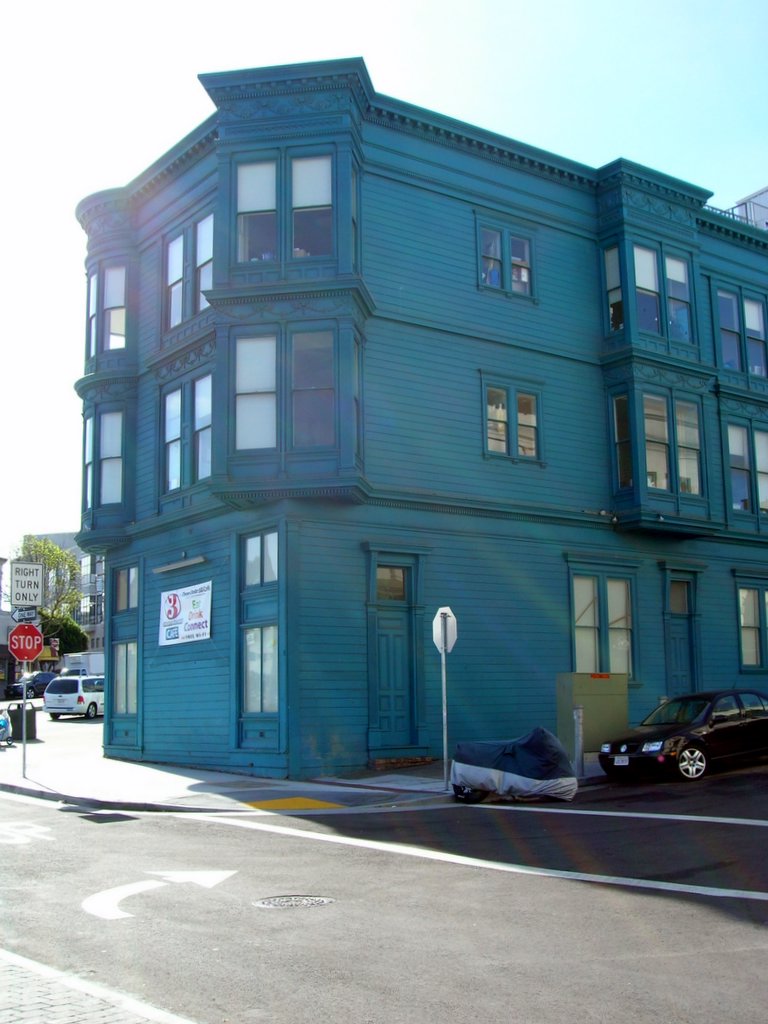
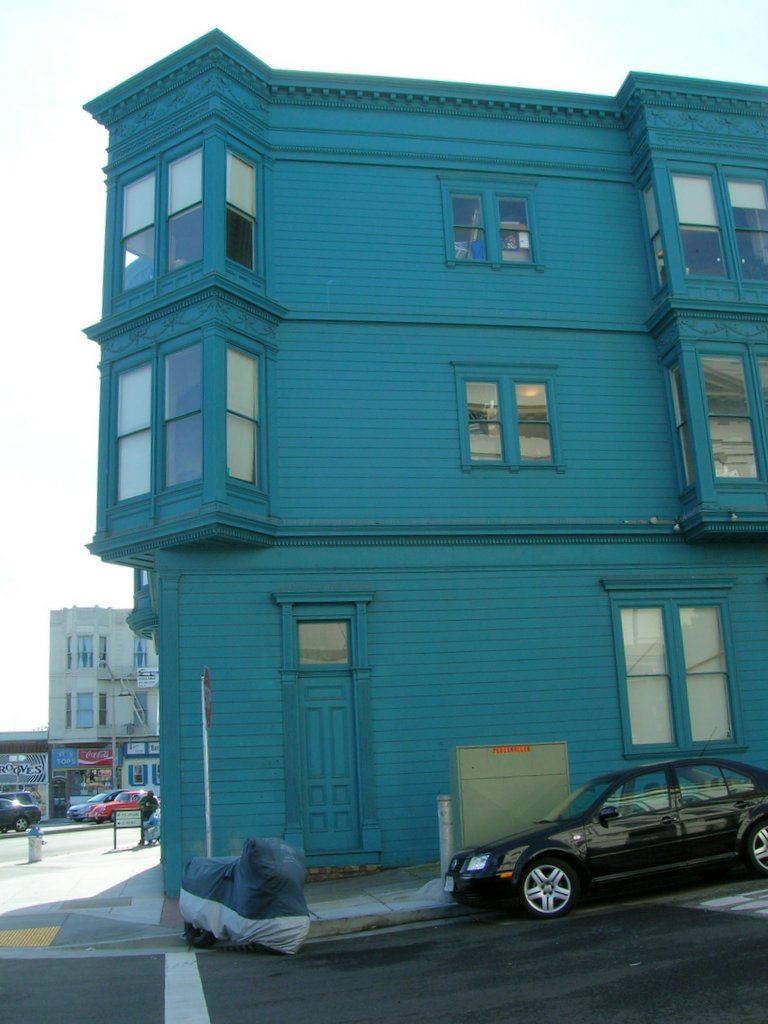
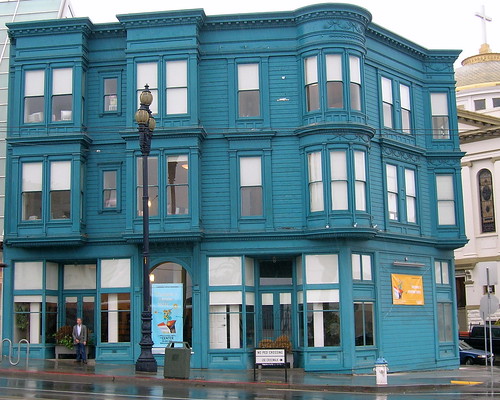

The house that Carmel built, The Fallon House at 1800 Market St, across the street from Destino, home to the best Pisco sours in the City.
The Fallon House was named for Carmel Fallon, his nibs' grandmother's grandmother.
Family history is there on the site.
Carmel Lodge Fallon grew up outside Santa Cruz on her mother's Mexican land grant. Rancho Soquel included land from the Santa Cruz Mountains ridgeline to the sea, from Santa Cruz to Watsonville. Martina Castro Lodge lost it all within years of the American influx. She divvied up the grant amongst her children, including Carmel, sold off the rest (with her much younger third husband as witness to the transaction) and years later died penniless and crazed.
Simon Cota, Carmel Lodge Fallon's father, died when she was a toddler. Carmel's mother, Martina Castro, then married Michael Lodge, whose last name Carmel adopted.
Carmel was the classic spinster rich girl who fell for the dashing Irish adventurer Thomas Fallon. They married and raised a family. The children died of cholera and they moved to San Jose (where Fallon had raised the Bear Flag many years earlier) to raise another family. Carmel, never an easy keeper, wound up whacking Fallon over the head (with what is sometimes called a fireplace tool, sometimes a lead pipe) when she found him in "a compromising position" with the housekeeper/dressmaker/maid some twenty-seven years into the marriage.
Carmel left San Jose and Tom and with her younger unmarried children in tow resettled in San Francisco, where she used her divorce settlement to become a business woman and landlord, owning and operating the Hotel Carmel and the Fallon Hotel.
Carmel never remarried. She built the house at 1800 Market Street and lived in it until her death. Family legend has it that she was up beating out embers on the roof, helping save the building from the fires after the 1906 quake and that for the rest of her life she suffered from "weak lungs" due to smoke inhalation. She did save the house, though. Her house was the first house left standing and unburnt on Market Street after the earthquake and fire.
Carmel Lodge Fallon was in her nineties when she died. Her great-grandson, his nibs' father, could remember visiting his great-grandmother when he was young. She wasn't your warm, cuddly great-grandmother but rather a dour old woman, dressed in black.
One of the children Carmel brought with her to San Francisco, Isabella (Belle) Fallon, married Nathaniel Jones Brittan of the City. His father, John Wesley Brittan, had been a young hardware store clerk in New York until the hardware store owner had the brill idea to send his young clerk out to California shortly after the Gold Rush with a shipload of hardware supplies to sell to the 49ers.
JW Brittan sold out all the supplies he'd brought, kept his share of the profits and settled in the City, bringing more hardware on other ships around the Horn. He made a good living selling hardware, pans and pick axes to the gold miners and hinges, door knockers and nails to the San Franciscans.
NJ Brittan and Belle had three children, a set of twins Natalie and Belle, and Carmelita, his nibs' grandmother. The girls were raised for the most part down the peninsula on NJ Brittan's Rancho San Carlos. NJ's name and the ranch are entwined in the history of what eventually became San Carlos. You can still see Brittan Avenue and streets named after Belle and Carmelita (but not Natalie, why?) from when the ranch was subdivided and sold.
As was the case with many of the Brittan and Fallon holdings, there were squabbles over rights and inheritances. Lawsuits and lawyers ate up what money and property there was. The Fallon House in San Francisco was sold to honor a pledge Carmel Fallon had made to the San Francisco Opera -- but only after the Opera had to sue Carmel's estate.
Eventually, and appropriately enough -- our older son's gay -- Carmel's house became San Francisco's LGBT Community Center.
And there ends a short history of Carmel Fallon's house at 1800 Market.
Labels: history, photographs, San Francisco
posted by Sal Towse at 11:28 AM|
|
|
I mentioned that I'd come across my copy of WEAVING THE WEB yesterday, inscribed "To Sal" by Tim B-L, my hero.
PJ Parks, who used to have a very readable blog but now no longer does, wrote that she has a copy too and talked about ENQUIRE WITHIN UPON EVERYTHING, a Victorian factoid book and the motivation for TB-L to name his proto-WWW project ENQUIRE.
Today, while sorting books and packing up boxes, I found a copy -- well, not the Brit version, mine is the American version: INQUIRE WITHIN FOR ANYTHING YOU WANT TO KNOW, or Over Three Thousand Seven Hundred Facts WORTH KNOWING. Particularly intended as a book for Family Reference on Subjects connected with Domestic Economy, and containing the Largest and most Valuable Collection of Useful Information that has ever yet been published. INQUIRERS ARE REFERRED TO THE INDEX. (New York: Dick and Fitzgerald, No. 18 Ann Street. 1858 [maybe 1856, the numeral didn't print clearly])
The book has all =sorts= of useful (and quaint and dated and sometimes flat out wrong) stuff.
e.g.
794. YULECAKE -- Take one pound of fresh butter, one pound of sugar, one pound and a half of flour, two pounds of currants, a glass of brandy, one pound of sweetmeats, two ounces of sweet almonds, ten eggs, a quarter of an ounce of allspice and a quarter of an ounce of cinnamon. Melt the butter to a cream, and put in the sugar. Stir it till quite light, adding the allspice and pounded cinnamon; in a quarter of an hour, take the yolks of the eggs, and work them two or three at a time; and the whites of the same must by this time be beaten into a strong snow, quite ready to work in. As the paste must not stand to chill the butter, or it will be heavy, work in the whites gradually, then add the orange-peel, lemon, and citron, cut in fine stripes [sic], and currants which must be mixed in well with the sweet almonds; then add the sifted flour and glass of brandy. Bake this cake in a tin hoop, in a hot oven, for three hours, and put twelve sheets of paper under it to keep it from burning.
795. TO WASH CHINA CRAPE SCARFS, &c. -- ...
2004. Why does a lamp smoke, when the wick is cut unevenly? -- Because the points of the jagged edge (being very easily separated from the wick) load the flame with more carbon that [sic] it can consume; and as the heat of the flame is greatly diminished by these little bits of wicks, it is unable to consume even the usual quantity of smoke. The same applies when the wick is turned up too high.
Some of the stuff in INQUIRE WITHIN is word-for-word what's in ENQUIRE WITHIN. The scarf washing article above, f'rex, is word-for-word except that the title is "To Wash China Crêpe Scarves, &c." in ENQUIRE.
Other bits of information (the one about lamp smoke, f'rex) are not covered by ENQUIRE WITHIN at all.
All-in-all fun stuff. You can see why TB-L called his project ENQUIRE -- there's more than a bit of resemblance to the random collection of stuff on the Web.
How prescient of him.
Project Gutenberg has made a copy of ENQUIRE WITHIN UPON EVERYTHING available. Did TB-L even dream sixteen years ago that his nifty little project would some day offer up ENQUIRE WITHIN UPON EVERYTHING for anyone with Web access?
Thanks, TB-L!
Labels: books, factoid, history
posted by Sal Towse at 8:41 PM|
|
|
You can Google all the particulars.
Jim and Artie were the godfathers of San Francisco smut.
Two friends from SJPL worked in San Francisco for a while back in the early seventies. The F half was the girl working the box office. She took your $ to get into the theater. The M half had experience working with the AV and film at San Jose Public: he cleaned the films after playing.
We always used to say that Richard cleaned dirty films for the Mitchell Brothers.
Ah, those were the days.
Labels: history, life, obit, San Francisco
posted by Sal Towse at 10:31 PM|
|
|
Two significant collections of previously classified historical documents are now available in the CIA's FOIA Electronic Reading Room.
The first collection, widely known as the "Family Jewels," consists of almost 700 pages of responses from CIA employees to a 1973 directive from Director of Central Intelligence James Schlesinger asking them to report activities they thought might be inconsistent with the Agency's charter.
The second collection, the CAESAR-POLO-ESAU papers, consists of 147 documents and 11,000 pages of in-depth analysis and research from 1953 to 1973. The CAESAR and POLO papers studied Soviet and Chinese leadership hierarchies, respectively, and the ESAU papers were developed by analysts to inform CIA assessments on Sino-Soviet relations.
According to ABC News The recruitment of mafia men to plan the assassination of Fidel Castro, the wiretapping and surveillance of journalists who reported on classified material, and the two-year confinement in the United States of a KGB defector -- those are just a few of the past CIA activities revealed in documents released Tuesday. [...]
Update:A more in-depth look at some of the "activities inconsistent with the Agency's charter" from The Seattle PI.
Labels: history, politics, resource, URL
posted by Sal Towse at 5:48 PM|
|
|
His nibs sez, "Hey. Look at this!"
Eric Burdon and the Animals are playing at the Chukchansi Gold Resort And Casino in Coarsegold, CA.
Oh.
[heart sinks]
Those were the days, my friend.
[/heart sinks]
posted by Sal Towse at 9:39 PM|
|
|
[...]
Bradbury, a man living in the creative and industrial center of reality TV and one-hour dramas, says it is, in fact, a story about how television destroys interest in reading literature.
"Television gives you the dates of Napoleon, but not who he was," Bradbury says, summarizing TV's content with a single word that he spits out as an epithet: "factoids." He says this while sitting in a room dominated by a gigantic flat-panel television broadcasting the Fox News Channel, muted, factoids crawling across the bottom of the screen.
His fear in 1953 that television would kill books has, he says, been partially confirmed by television's effect on substance in the news. The front page of that day's L.A. Times reported on the weekend box-office receipts for the third in the Spider-Man series of movies, seeming to prove his point.
"Useless," Bradbury says. "They stuff you with so much useless information, you feel full." He bristles when others tell him what his stories mean, and once walked out of a class at UCLA where students insisted his book was about government censorship. He's now bucking the widespread conventional wisdom with a video clip on his Web site (http://www.raybradbury.com/at_home_clips.html), titled "Bradbury on censorship/television."
As early as 1951, Bradbury presaged his fears about TV, in a letter about the dangers of radio, written to fantasy and science-fiction writer Richard Matheson. Bradbury wrote that "Radio has contributed to our 'growing lack of attention.'... This sort of hopscotching existence makes it almost impossible for people, myself included, to sit down and get into a novel again. We have become a short story reading people, or, worse than that, a QUICK reading people."
[...]
"I was worried about people being turned into morons by TV," Bradbury says in the censorship/television video clip. The collection of clips includes his explanation of how he wrote Fahrenheit 451 in nine days in a clip titled (oddly enough) FAHRENHEIT 451.
The Bradbury site also includes a wonderful obit for Marguerite Susan McClure (Maggie) Bradbury, who died in 2003.
Labels: biography, books, history, obit, video
posted by Sal Towse at 1:44 PM|
|
|
We're bringing Trollope's world to life with character descriptions, plot summaries, details of Trollope's career as well as free e-texts of the novels to download.
It's the 150th anniversary of Barchester Towers. Stop on by. Grab a piece of cake!
The folks behind the site are giving away 50 copies of Barchester Towers. You can't win unless you enter. Deadline 30 June 2007.
Must be resident of UK to win. (It's not fair, Mom!)
Labels: books, contest, history, URL
posted by Sal Towse at 12:52 PM|
|
|
[...]
The typeface's dominance over the past half-century, cemented by the release of Neue Helvetica in the 1980s, has now inspired a documentary, Helvetica, and exhibitions on both sides of the Atlantic.
Bland uniformity
But not everyone is a Helvetica lover. Type "I hate Helvetica" into Google and there are forums for people who rage at the mindless "corporate chic" of this dominant font. They see it as a vehicle for social conformity through consumerism, shifting product with a great big steam-roller of neutrality.
[...]
posted by Sal Towse at 8:51 AM|
|
|
Seems Traisman bought the first McDonald's franchise in Madison, WI, in the late 1950s. At the time there was a problem getting the fresh potatoes to make fries. (McDonald's fries at that time were made fresh in each location.) Ray Kroc asked Traisman to help work on the problem of making tasty frozen fries and a "Method for Preparing Frozen French Fried Potatoes" (a Traisman innovation) was patented in 1962.
But wait. There's more.
Before becoming a McDonald's franchisee, Traisman was director of food research at Kraft where he was instrumental in the development of Cheez Whiz cheese spread, instant pudding and other food products.
Cheez Whiz AND McDonald's french fries! Where would we be today without Traisman?
Labels: culture, history, obit
posted by Sal Towse at 12:00 PM|
|
|
(Found while tracking down information about Jean Eugène Robert-Houdin and his automatons.)
posted by Sal Towse at 4:17 PM|
|
|
Welcome to my "virtual" radio and scientific instruments museum where I display the radios and other items I have collected over the past 35+ years. I hope you enjoy them as much as I do. I'm always interested in early wireless, radio, scientific and other electrical items up to about 1920 (including books and other publications)
Highlights of Jenkins' collection.
This site is amazing. A prime example of Web sites offering up a treasure trove of information simply because someone (in this case Jenkins) has a passion for a subject.
(Found whilst searching for information on Geissler tubes.)
posted by Sal Towse at 4:07 PM|
|
|
No kidding. How cool is that?
Started a little over two years ago (15 May 2005), Sparkletack now has an archive of sixty podcasts covering a wide range of San Francisciana.
Enjoy.
Labels: history, podcast, San Francisco
posted by Sal Towse at 2:31 PM|
|
|
Wide-ranging collection of materials on the Galápagos Islands, Ecuador, collected by the author of CHARLES DARWIN SLEPT HERE.
Ephemera, maps, texts, factoids. Darwin's Journal. Darwin's Diary. H.M.S. Beagle logs. Eleanor Roosevelt "My Day" (her description of her trip to the Galápagos in 1944).
More.
Labels: history, science, travel, URL
posted by Sal Towse at 12:49 PM|
|
|
Some day (I have fifty or so more years, after all) I will learn me better French than I have and take a crack at reading the things she read while she was cooped up, unable to get home. That's the intent anyway. The old family books in French and Italian and German, the Spanish-Greek dictionary and the like, show that Americans, at least those in his nibs' family, used to be far more fluent in languages than we are today.
Northwestern University's McCormick Library of Special Collections has a terrific collection of photographs and images of the Siege and Commune of Paris (1870-1871).
This site contains links to over 1200 digitized photographs and images recorded during the Siege and Commune of Paris cir.1871. In addition to the images in this set, the Library's Siege & Commune Collection contains 1500 caricatures, 68 newspapers in hard-copy and film, hundreds of books and pamphlets and about 1000 posters. Additions are made regularly.
Search by word or phrase, browse by image type, scroll through the master index (title) and the subject index.
The collection doesn't let you just click [next] and get to the next item, which would be swell. You must click a link, check out the item, go back to the link list, click another link ...
Even so ... you are there and sometimes elsewhere and not always in the narrow date span that the title of the collection implies. Some of the photographs come from the early 1900s, f'rex, and yet, if you like looking at old photographs of people and buildings, come along and wander through this archive.
Amazing thing, this World Wide Web.
Labels: history, photographs, URL
posted by Sal Towse at 9:30 AM|
|
|
WELLINGTON, New Zealand (AP) -- Wreckage from a World War II torpedo boat was tossed up from the sea in the Solomon Islands after a powerful 8.1 earthquake hit the area in early April, an official said Friday.
Jay Waura of the National Disaster Management Office said the explosive-laden boat was exposed when reefs were pushed up three meters (10 feet) above sea level by the April 2 quake, which caused a devastating tsunami in the western Solomon Islands that killed 52 people.
The Solomons' coastline is still littered with decaying military wrecks from World War II, including the torpedo patrol boat commanded by U.S. President John F. Kennedy.
[...]
Do you have your earthquake kit ready?
posted by Sal Towse at 5:25 PM|
|
|
Film clip of the opening of the world's largest bridge. 1937.
[spotted on Curbed SF]
Labels: history, San Francisco, SFOBayBridge, video
posted by Sal Towse at 3:36 PM|
|
|
Today (08 Mar) brings us
Lord Byron: March 8, 1816
A letter to Thomas Moore.
I rejoice in your promotion as Chairman and Charitable Steward, etc., etc. These be dignities which await only the virtuous. But then, recollect you are six and thirty, (I speak this enviously—not of your age, but the "honour—love—obedience—troops of friends," which accompany it,) and I have eight years good to run before I arrive at such hoary perfection; by which time,—if I am at all,—it will probably be in a state of grace or progressing merits.
[...]
Labels: blog, books, history, writing
posted by Sal Towse at 5:04 PM|
|
|
Researchers from Ancestry .com traced Sharpton's roots using a database with access to 5 billion records including birth and death certificates, slave narratives, census and bank records, and United States Colored Troops documents.
They discovered that Sharpton's great-grandfather Coleman Sharpton was a slave owned by Julia Thurmond, whose grandfather was Strom Thurmond's great-great-grandfather.
"I know there's no such thing as a boring family tree," said the chief family historian for Ancestry.com, Megan Smolenyak, who presented the findings to Sharpton on Thursday. "I knew we would find something, but I certainly didn't anticipate this."
The information also showed his [Sharpton's] great-grandfather had been freed. Smolenyak said Sharpton was subdued and stunned when she told him about his family history.
Interesting histories.
Interesting times.
Update: Sharpton Wants DNA Test
posted by Sal Towse at 12:15 AM|
|
|
Not just European and North American anymore. Also includes images from Vietnam and Cambodia.
Mary Ann Sullivan, Bluffton University, has pulled together more than 13,000 images. Index. Monthly featured site. More.
Labels: architecture, art, history, URL
posted by Sal Towse at 12:36 PM|
|
|
I love old dictionaries. The actual wordstuff for this one begins at page 31, after all the frontal matter regarding pronunciation and all that.
Seeing how a word was used in 1865 gives one a glimpse at how the current day definition evolved. Some words in Worcester's dictionary have evolved beyond recognition. Some no longer exist.
e.g. p 168 (lacerable - lapful)
laconism - pithy phrase or expression
Lady-Day - 25th March. The Annunciation.
laic- a layman; -- opposed to clergyman.
lamantine - an animal; manatee or sea-cow.
lambative - a medicine taken by licking
laniate - to tear in pieces; to lacerate
lanuginous - downy; covered with soft thin hair
Some of those words are still in use today, although perhaps not in as common use as they were 142 years ago. "lanuginous" was used in the 2006 Scripps National Spelling Bee finals.
Fun stuff, words.
Labels: books, history, information, URL, wordstuff
posted by Sal Towse at 2:20 PM|
|
|
A description of the scoring method and a list of the people on the nominating committee are given. The top ten books are described in detail.
The books?
- The Communist Manifesto Authors: Karl Marx and Freidrich Engels
- Mein Kampf Author: Adolf Hitler
- Quotations from Chairman Mao Author: Mao Zedong
- The Kinsey Report Author: Alfred Kinsey
- Democracy and Education Author: John Dewey
- Das Kapital Author: Karl Marx
- The Feminine Mystique Author: Betty Friedan
- The Course of Positive Philosophy Author: Auguste Comte
- Beyond Good and Evil Author: Freidrich Nietzsche
- General Theory of Employment, Interest and Money Author: John Maynard Keynes
Also included on the list: - The Population Bomb by Paul Ehrlich
- What Is To Be Done by V.I. Lenin
- Authoritarian Personality by Theodor Adorno
- On Liberty by John Stuart Mill
- Beyond Freedom and Dignity by B.F. Skinner
- Reflections on Violence by Georges Sorel
- The Promise of American Life by Herbert Croly
- Origin of the Species by Charles Darwin
- Madness and Civilization by Michel Foucault
- Soviet Communism: A New Civilization by Sidney and Beatrice Webb
- Coming of Age in Samoa by Margaret Mead
- Unsafe at Any Speed by Ralph Nader
- Second Sex by Simone de Beauvoir
- Prison Notebooks by Antonio Gramsci
- Silent Spring by Rachel Carson
- Wretched of the Earth by Frantz Fanon
- Introduction to Psychoanalysis by Sigmund Freud
- The Greening of America by Charles Reich
- The Limits to Growth by Club of Rome
- Descent of Man by Charles Darwin
Six of these titles I've never heard of: Gramsci, Webb, Croly, Sorel, Adorno, Comte. (Yes, I'm sure not knowing Comte brands me jejune. Alas, that I am.) Five I read as part of the two-year Humanities series in college: Nietzsche, Fanon, JSM, Marx and Marx & Engels. Others I read on my own, including Carson, Skinner, Ehrlich, Reich.
Of the thirty titles listed, I've read (if memory serves) twelve, maybe thirteen. Those unread? Well, doesn't this list make you want to go out and read those you've missed, and reread those you have only a hazy memory of?
I came across this list today from a mention in John Baker's blog where he adds the comment, They turn out to be books that have a point of view different to the panel of conservatives who selected them. No surprises.
If I were to list what I thought were the "most harmful" books, of course the "most harmful" books would be those written by people with a viewpoint that I find poisonous. No surprises indeed.
My list of books would differ in many respects.
I'm having a problem coming up with a list of "harmful" books. Yes, millions of copies of Mein Kampf were published in Hitler's Germany, but was the book itself the cause of Hitler's Germany? How closely did the Soviet Union apparatchiks adhere to the dictums of Marx and Engels and Lenin? Would Communist China have never existed if the little red book had not been published?
My list of harmful books would include:
- [FICTION] The Turner Diaries by Dr. William Luther Pierce (under the pseudonym Andrew Macdonald). Pierce is a white supremacist. This is his ode to the fictional day in the glorious future when the white race will exterminate the vermin who are not white and will rule the world. Yippy ky yay.
- [FICTION] The Protocols of the Meetings of the Learned Elders of Zion -- purported to be true, btw, by not just a few folks.
- [FICTION] The Left Behind series by Jerry B Jenkins/Tim LaHaye
[note: I wandered over to John Baker's blog from a post at This Thing Of Ours. Thanks for the headsup!]
posted by Sal Towse at 11:19 AM|
|
|
Making of America (MoA) is a digital library of primary sources in American social history from the antebellum period through reconstruction. The collection is particularly strong in the subject areas of education, psychology, American history, sociology, religion, and science and technology. The collection currently contains approximately 10,000 books and 50,000 journal articles with 19th century imprints. For more details about the project, see About MoA.
Amazing collection of stuff.
I was wandering around today trying to see if I could find some written context for "The man who doesn't read books has no advantage over the man who can't read them" (and variations), attributed to Mark Twain -- a discussion that popped up yesterday on Project Wombat (formerly, the Stumpers list).
I never did find confirmation or attribution for the alleged Twain quote, but I did find an essay -- patronizing to say the least -- explaining to the dear little women what sorts of books they should be asking for their husband's permission to buy and read: a six-page article titled, "Reading," by L.L. Hamline, found in "The Ladies' repository: a monthly periodical, devoted to literature, arts, and religion."
Whoo boy.
With the thousands of books and thousands of articles the MOA folks have scanned and continued to scan, you could spend a long while in these archives.
Maneuverability is good. The search is FAST and can be simple, Boolean, &c. MOA pulls up matches giving title &c. and number of pages your search terms are on. You can wend through the pages of a given work or ask for those specific pages within the work that have your search term(s).
The app doesn't highlight the found word on the page, which is unfortunate when you have a dense page filled with tiny print.
Interesting stuff. A peek into where we've come from.
Labels: books, history, information, URL
posted by Sal Towse at 12:52 PM|
|
|
Everything changes. You can make
A fresh start with your final breath.
But what has happened has happened. And the water
You once poured into the wine cannot be
Drained off again.